

Colt Double Eagle Review: The 1911 Apostate
The 1911’s single-action trigger is a tactical sacrament.
Clean. Crisp. Direct. Just as Yahweh and John Browning intended it. Every time you pull the trigger, it’s like asking Jesus to put a bullet right where you want it. And the Lord delivers. Eth.
So, any 1911 that strays from John Moses Browning’s blessed vision…
Is a heretic. An infidel. A vile apostate.
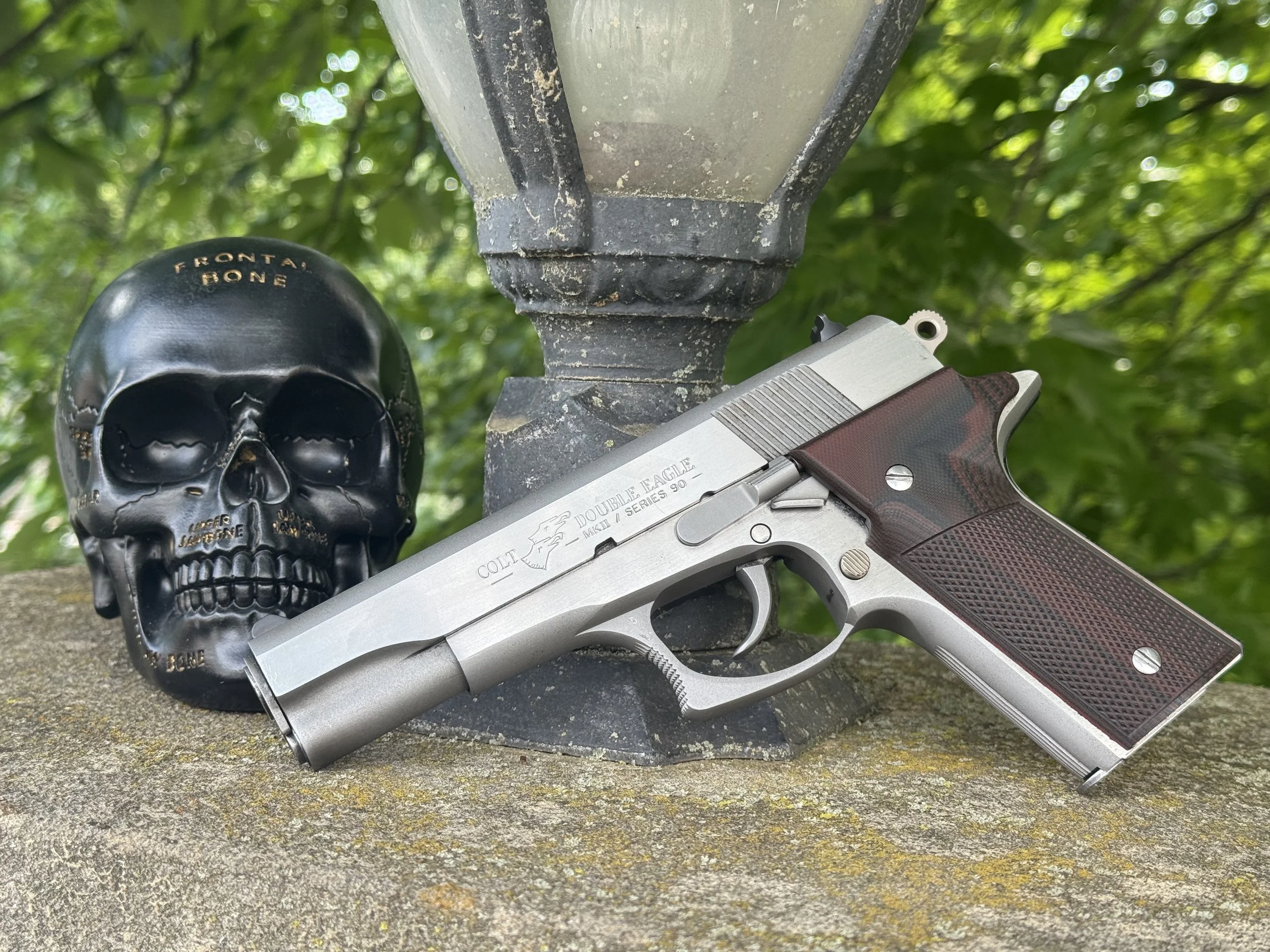
Tactical blasphemy
That brings us to the Colt Double Eagle. It’s a 1911. Basically. But it abandons the sanctity of JMB’s single-action miracle, and embraces the sacrilege of a DA/SA fire-control system. Not to mention some “curious” ergonomics.
And yet…
As I stand before you—dangling my fate before the grand inquisition of internet fudds and unconvincingly jaded tactical bros—I feel compelled to say…
That I love the Double Eagle. Legitimately and un-ironically.
Even its goddamn trigger.
What makes the Colt Double Eagle HipTac worthy?
Essentially a DA/SA 1911, the Double Eagle’s contentious rejection of Browning orthodoxy has long overshadowed its remarkably competent—albeit eccentric—shooting dynamics.
If you envision gun culture as a mob of angry peasants dragging a witch to her fiery doom…
The Colt Double Eagle is that witch.
From gun rags, to forum rants, to YouTube diatribes, the Double Eagle has seen little mercy in the court of tactical opinion. It’s been endlessly belittled and besmirched. Relegated to tactical obscurity. Typecast as a floundering mess of last-minute engineering and corporate ineptitude.
All because…
It doesn’t fit cleanly into the conceptual “boxes” we’ve foisted upon the tactical landscape.
That’s not to say the Double Eagle is perfect. It has some legitimately annoying quirks—mainly ergonomic niggles, in my opinion. But they’re niggles. They’re minor. They’re superficial.
And when you look past those mildly puzzling ineptitudes…
BOOM!BOOM!BOOM!
…you realize this thing can hammer 230gr slugs into a single hole about as well as any .45 out there. And it does so with a refreshingly unconventional gusto that need not answer to any higher authority.
Other than its own competencies as a shooter.
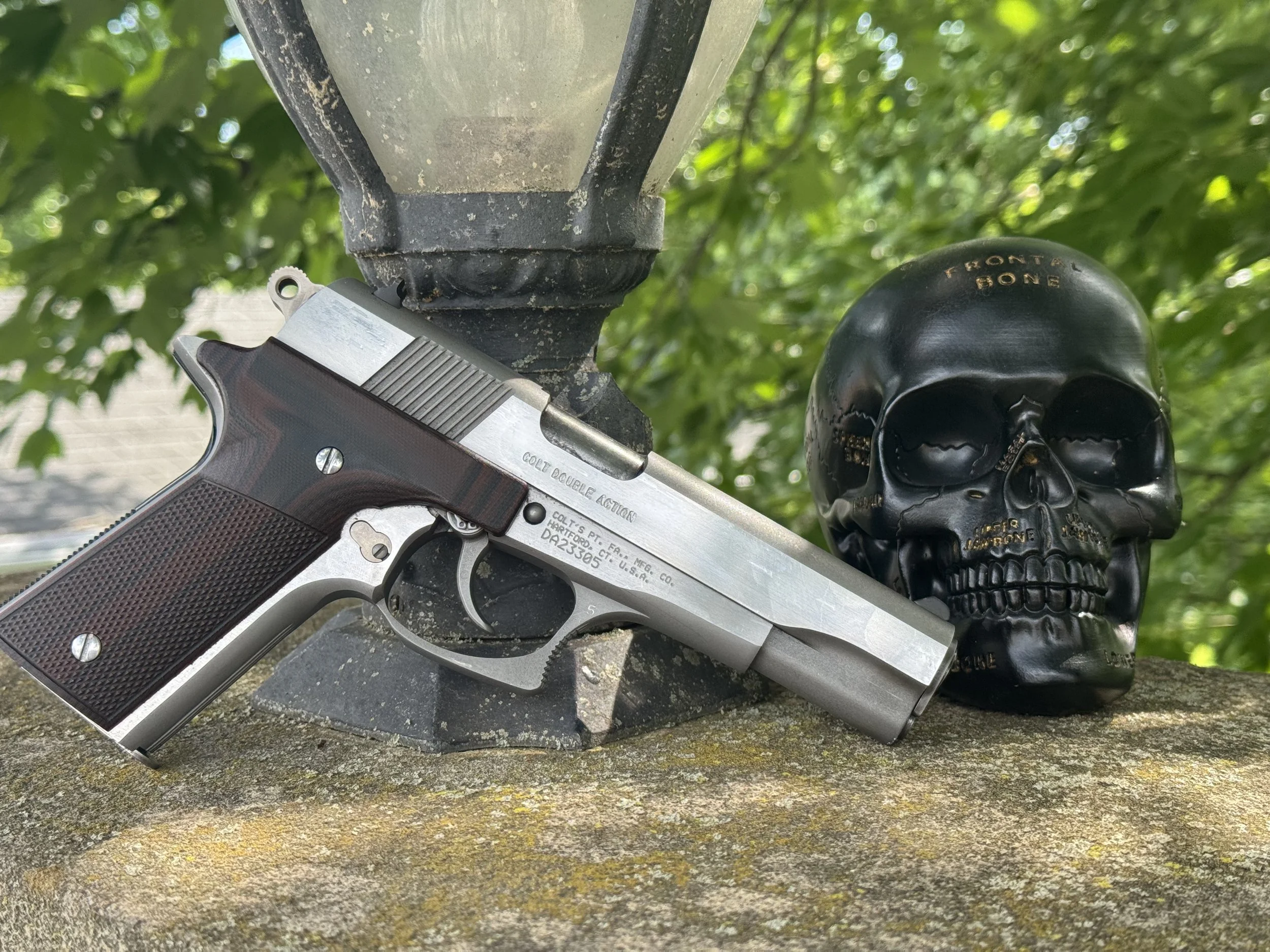
“Colt Double Action”—profane words
Moreover, it’s been reliable—with a few magazine-related caveats. Plus, the thing is very well made. It has a better fit, finish and cleaner machining than what one finds on Smith & Wesson DA/SA pistols from the same era.
And I promise you…
The _uck!ng springs DON’T fly out when you take the grips off. More on this later.
Forbidden Fruit
In the years before I knew anything about guns… women… or gluten-free beer…
I once saw a picture of a Colt Double Eagle.
It stirred those primal “juices” within me. The clean, stainless aesthetic, punctuated by a preponderance of levers and linkages. The rakish lines of the frame, angling down into the chunky proportions of the grip.
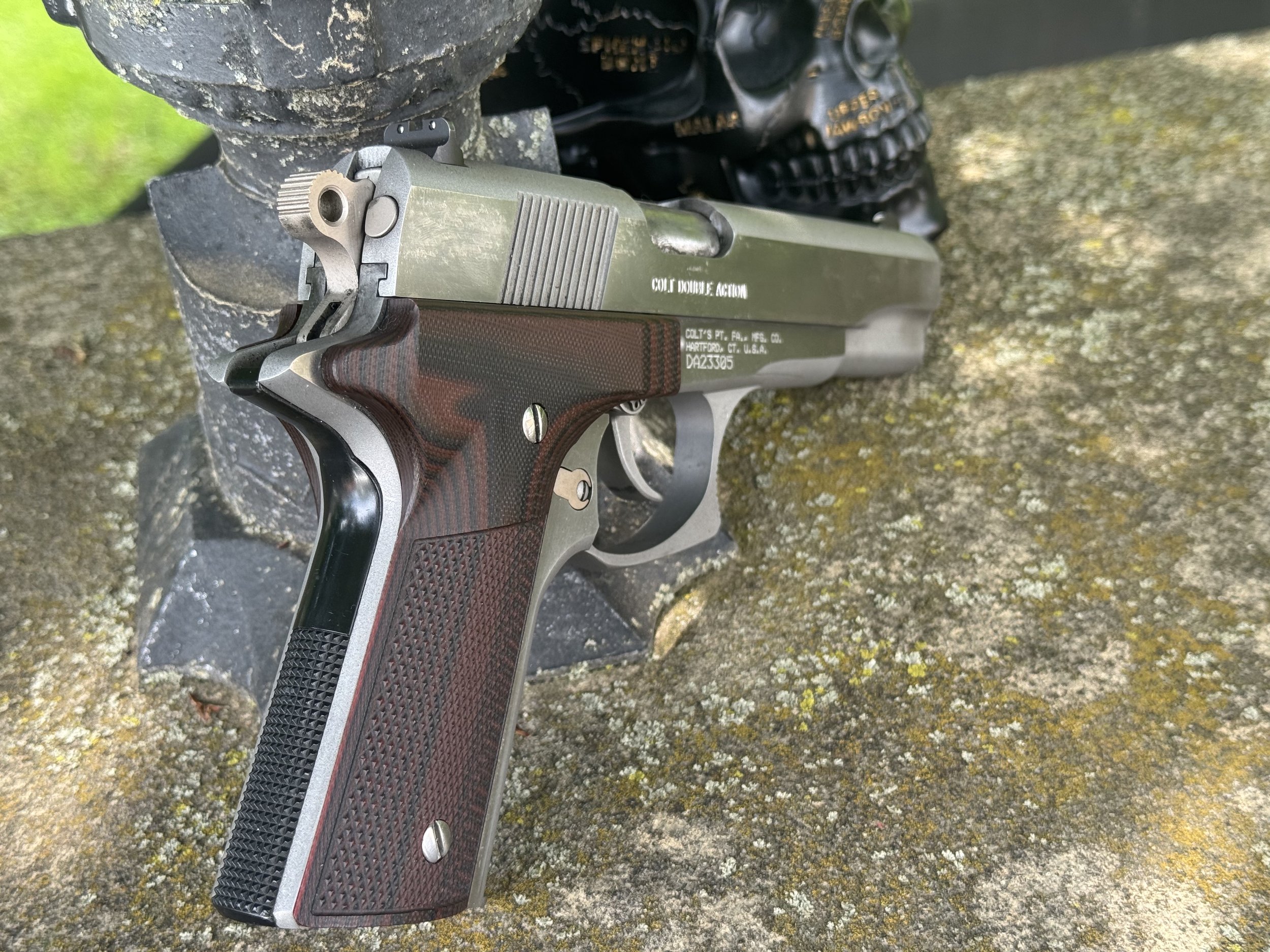
Hefty haunches
It looks industrial. Post-industrial, even. It captures the sleek—yet heavy-duty—aesthetic that still captivates my Gen-X aesthetic sensibilities. It is, perhaps, the handgun equivalent of James Cameron’s T-800.
And when I realized everyone hated it…
I wanted one even more.
Which brings us back to the Double Eagle’s sad story.
Identity Crisis
Made from 1989 to 1996, the Double Eagle represents Colt’s attempt to win law-enforcement contracts in the heyday of DA/SA duty pistols. Suffice to say, it did not succeed. And it did no better on the civilian market.
But why?
I think the Double Eagle’s downfall lies in that fact that it’s really two things: A 1911 and a DA/SA service pistol. And, as either one, it faced a losing proposition:
1911 guys saw it as heresy.
DA/SA guys saw it as a half-@ssed attempt.
As such, police departments opted for more established, more proven DA/SA platforms from Smith & Wesson and SIG Sauer. Civilians? They just latched onto whatever the gun rags said. And the gun writers of the day just weren’t gonna embrace a 1911 that… well…
Didn’t behave like a 1911.
To drive sales, Colt offered the Double Eagle in multiple calibers (.45 ACP, 10mm, .40 S&W) and multiple sizes (Government, Commander, Officer). They also introduced a “product improved” version—called the MKII—in 1991 or 1992. While Colt hoped this might assuage negative perceptions of the gun’s quirky mechanics…
It didn’t.
My gun is a 1996 Government-sized MKII model, chambered in .45 ACP. Later in the review, I discuss what actually changed in the MKII model. Spoiler Alert: It ain’t much.
Also…
The gun’s appearance didn’t help its plight, either. While I personally love the Double Eagle’s uniquely “mechanical” aesthetic…
The DA/SA parts do look like they’ve been “Frankensteined” onto a 1911. The frame has a deep sagittal cut to house the massive bearing for the trigger shoe. The trigger bar runs externally along the frame, not-so-subtly hidden by an extended grip panel.
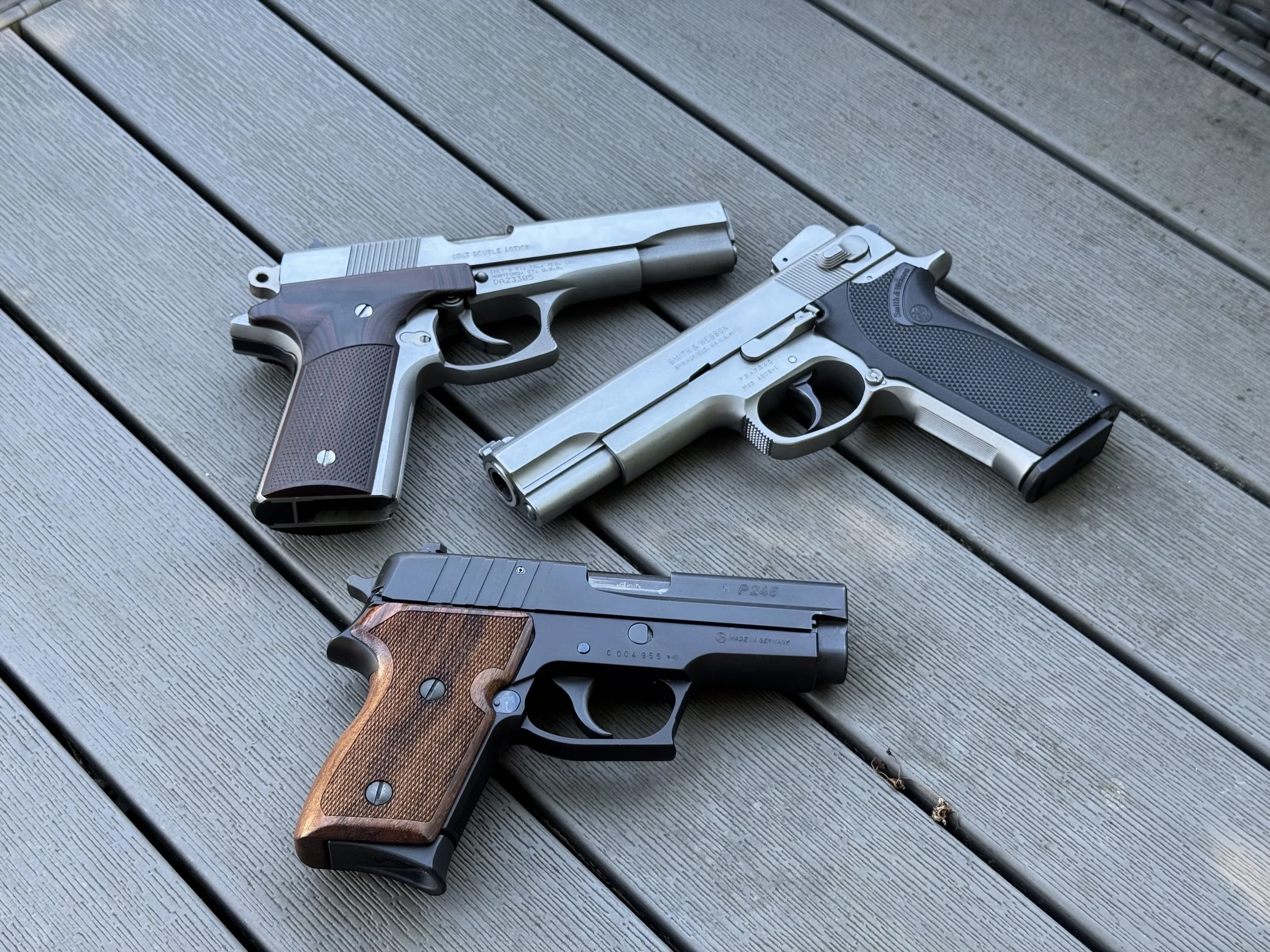
Whereas the Smith & Wesson 4506 and the SIG Sauer P220 were built from the ground up as DA/SA pistols…
The Double Eagle looks like a modified 1911. Which it is.
So, let’s talk about that.
Is it a 1911?
The Double Eagle shares all the following parts with a standard 1911:
Barrel
Bushing
Extractor (Series 80)
Ejector
Swinging Link
Slide Stop
Firing Pin / FP Stop
Recoil Spring
Sights
Magazines
Yes—you can use normal-as$ 1911 mags in a Double Eagle. As well as all the other parts listed above. The slide is more or less the same too, aside for a specific cut to incorporate the Double Eagle’s proprietary disconnector.
So, from a functional standpoint, I see the Double Eagle as more 1911 than not. And since most of the wear parts are standard 1911 fare, maintaining one of these things is basically like maintaining any 1911.
But we’ll talk more about some proprietary parts you might wanna keep an eye on.
To that point…
From the slide down, the Double Eagle is a different animal.
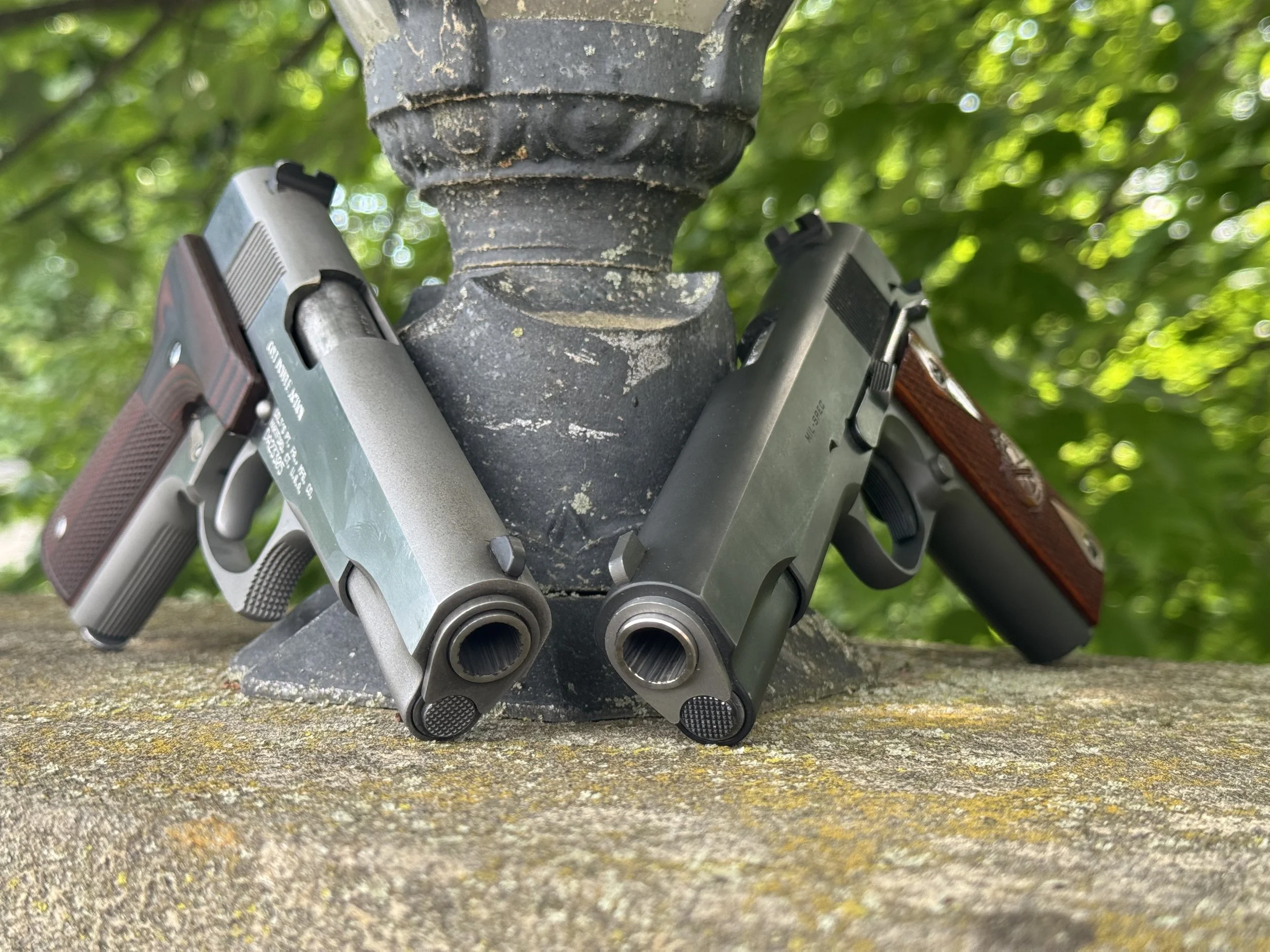
Bushing bros
Obviously, DA/SA lockwork wasn’t gonna fit into a standard 1911 frame. That’s why the Double Eagle’s frame angles down, from front to back: it creates more room for the DA trigger bar, decocker and sear—which sits lower in the gun than a standard 1911 sear.
Moreover, the extra DA doodads—and the extra steel in the angled frame—add weight to the gun. It definitely feels heavier than a standard 1911. But in a good way, if you ask me. In the hand, the thing exudes a superbly satisfying sense of heft.
It feels like a machine… that also happens to be a handgun.
The revised frame design also changes the ergonomics. Which—for 1911 purists—is perhaps an unforgiveable sin.
But, to me, “different” doesn’t necessarily mean “wrong.”
Let’s discuss.
More Than Bore Axis
Thanks to the angled frame, the trigger guard and the beavertail both come down lower versus a normal 1911. This forces your hand lower on the grip.
So, “yes”—the Double Eagle has a high bore axis. It feels like the slide is sitting on top of your hand, not in front of it. Imagine holding a 1911, but with the bore height of a classic SIG or a Ruger P89.
Now, on the front strap, Colt did a good job undercutting the trigger guard—so the downward shift is minimal.
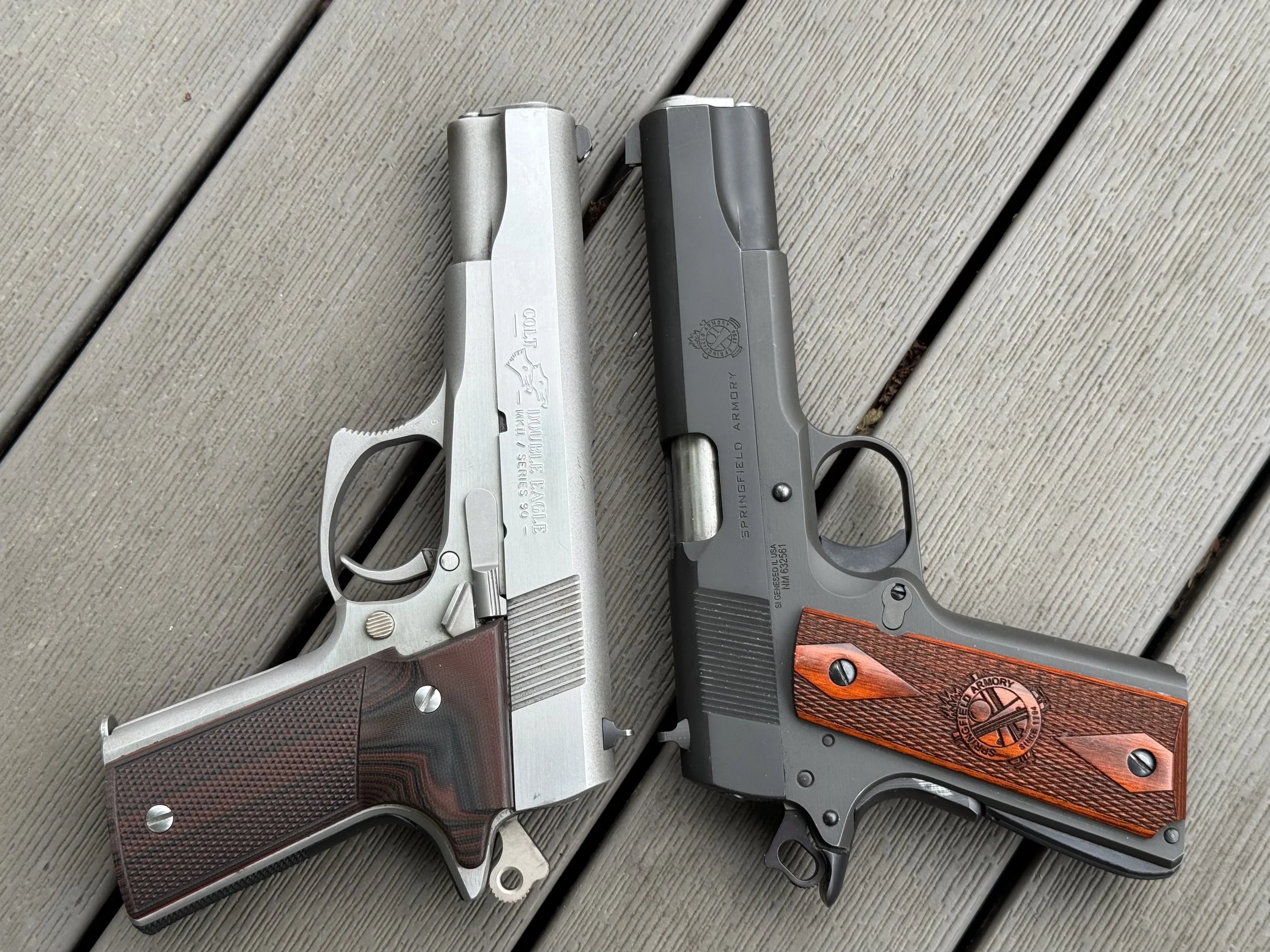
That sexy rake…
But here’s the thing…
Albeit subtle, the lowered trigger guard changes the angle of your fingers, relative to the front strap. So, you feel yourself pinching down into the bottom/front of the grip. Handling and shooting the gun, I notice that more than the higher bore axis.
I’ll be the first to tell you…
It doesn’t feel as natural as a true 1911.
I’ll also be the first to tell you…
I don’t really give a sh!t.
Lightning Precision
BOOMBOOMBOOMBOOM!
I can’t write enough “BOOMs” in all caps to capture the absurd profundity of how fast you can shoot this _ukc!ng thing. And, bro—this is a .45. Not some steel brick of a 9mm, like a CZ Shadow 2.
Yes. It has a high bore axis.
Yes. It has more muzzle rise than a standard 1911.
Yes. It has a long slide, with considerable reciprocating mass.
No. None of that really matters.
Because, for one, the trigger reset on this gun is freakin’ bonkers. It’s stoopid short. It makes a SIG Short Reset Trigger feel like it’s measured in geologic time.
But it’s not JUST short. It’s the way the trigger shoe pushes your finger EXACTLY back to the wall—which is impeccably firm, with zero creep. It’s not exactly light. Maybe 5lbs. But that gives you leeway to pre-stage your pull for the next shot.
BOOM! Bullseye.
You find that super-firm wall. Then all it takes is a subtle nudge into the brea—
BOOM! Bullseye.
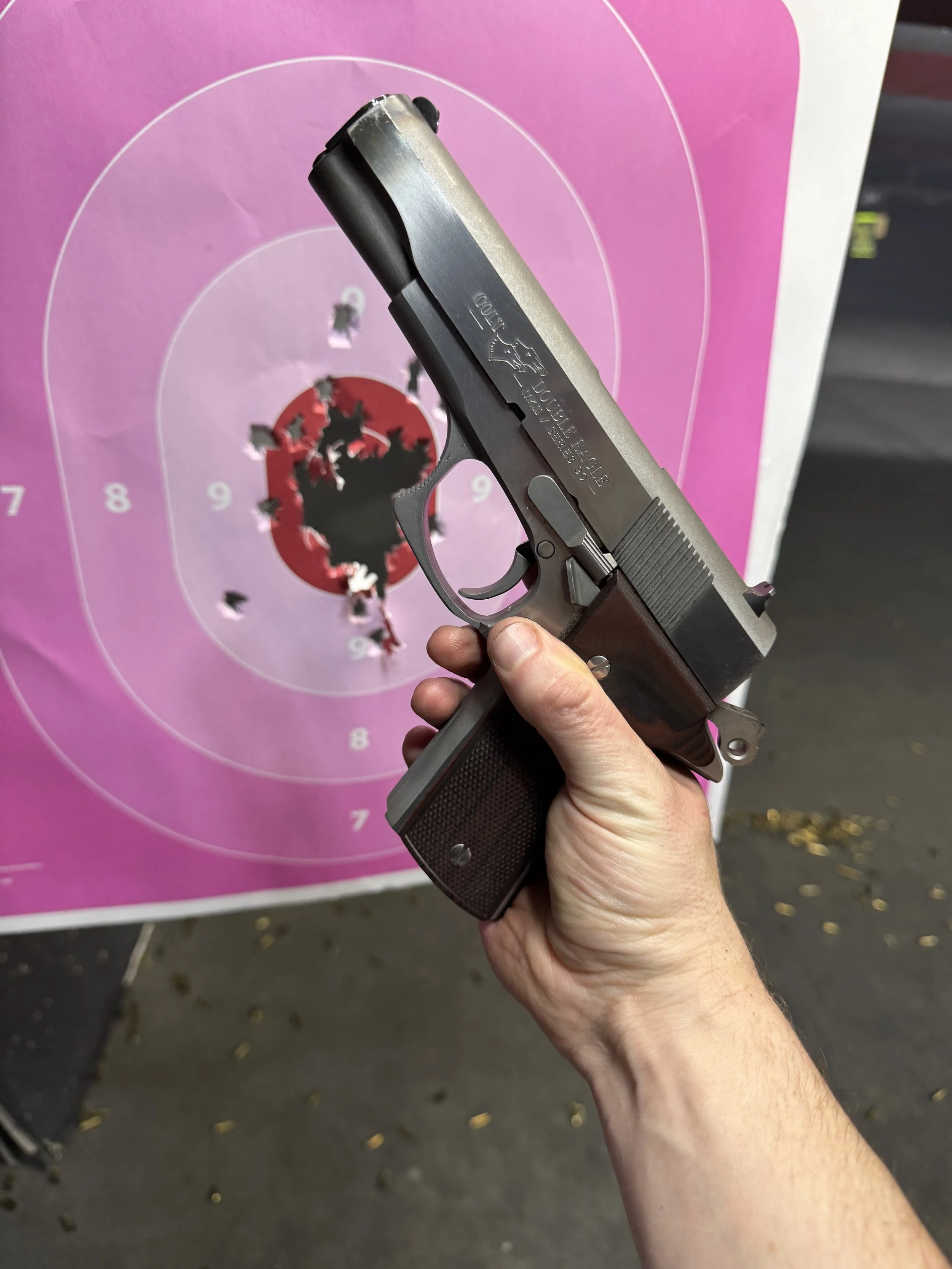
Is your 1911 mad?
No. It doesn’t offer the sheer “tactile satisfaction” of a classic 1911 trigger. But the incisive crispness of the break makes shot placement easy. And when you combine that with the insanely short reset…
BOOMBOOM! BOOMBOOM!
Fast. Precise. Clean. The thing is a godd@mn American ninja. And, dare I say…
It puts the moves on a target faster—with more gusto—than a normal 1911. Or a Smith 4506. Or a SIG P220.
Roll With It
However, like all ninjas in .45 ACP, it has some kick. And this one kicks the muzzle up, thanks to the high bore axis.
But…
Remember how I talked about the angle of your fingers on the front strap? That works in your favor here.
As I said, you’re always kinda pinching down into front strap, thanks to the lowered trigger guard—more so than you would on a standard 1911. That extra downward torque helps pull the muzzle down under recoil…
BOOM! BOOM!
You feel energy of the .45, yes. But not straight back into your bones. As long as you have a firm hold, the altered grip geometry passively mitigates muzzle rise—and so does the added weight.
To me, the thing shoots softer than a standard 1911. Seriously.
Just with more of a bounce.
BOOMBOOMBOOMBOOM!
You just gotta roll with it, baby.
That said…
Adding some grip traction DEFINITELY helps you control that big-bore bounce. Especially since you’re contending with a higher bore axis. The factory grip panels are mad slick, and I had some low-left BS on my first few range trips.
I was lucky enough to find a pair of G10 grips (made by VZ for a few years) floating around the internet. They feel fantastic. They look fantastic. Though skateboard tape works just as well.
Double Action Stackin’
If you’re into DA/SA guns, you encounter various “archetypes” of DA trigger pulls. You’ve got gliders, crunchers, stackers, scrapers, over-travelers, etc.
Well, this one is a stacker. In fact, it stacks sooo much, the trigger literally stops… right before the break. It’s almost like shooting an SA trigger at the point. Interestingly, I find my Walther P5 works pretty much the same way.
I mean, yeah… a truly consistent DA stroke is preferable. But it’s honestly easy to find the stopping point before the break. You get it there, then you just…
BANG!
It’ll put a round where you want it.
Different is Different
Once you get a sense of how the trigger breaks and the recoil flows, shooting the Double Eagle starts to feel intuitive and instinctive. But in its own way—regardless of how it compares to a 1911.
In fact, I find it doesn’t feel much like a 1911 at all. From a shooting standpoint.
It’s heavier. It’s bouncier. It’s got more attitude. The trigger is definitely its own thing. Regardless, it throws lead right where you want it—even when you’re pushing your splits. If you do your part, of course.
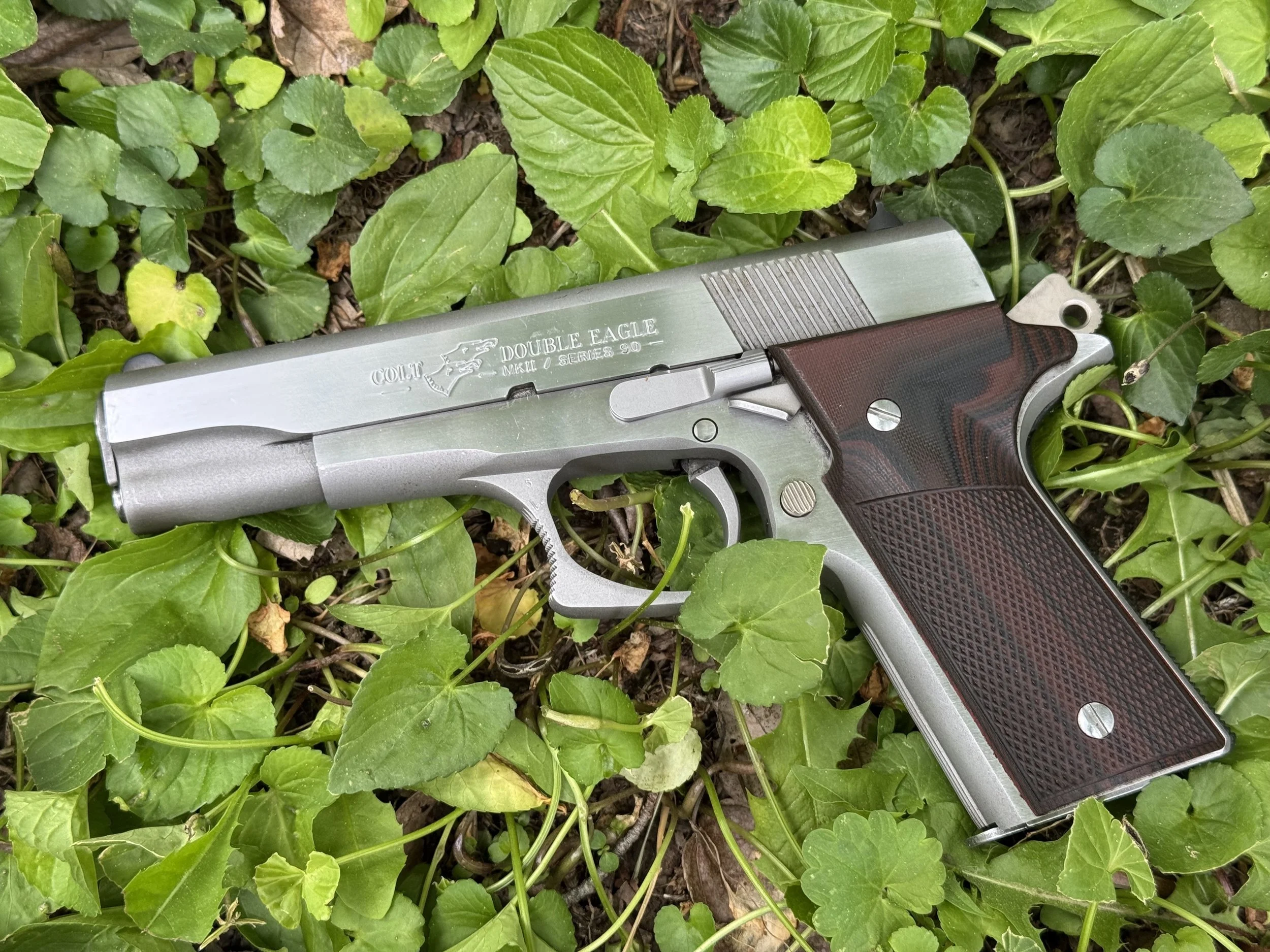
Different looks good
So, I really do like the gun. And not just because it’s different and kinda rare. I genuinely like the way it handles and shoots. And, of course, it offers DA/SA functionality, which is my preferred manual of arms.
Still…
I ain’t gonna lie. The thing does feel kinda weird in some ways.
ErgoNomalies
And not “deal breaker” weird. Again, these are things that raise an eyebrow—but don’t ruin the experience. At least for me.
Front-Strap Awkwardness
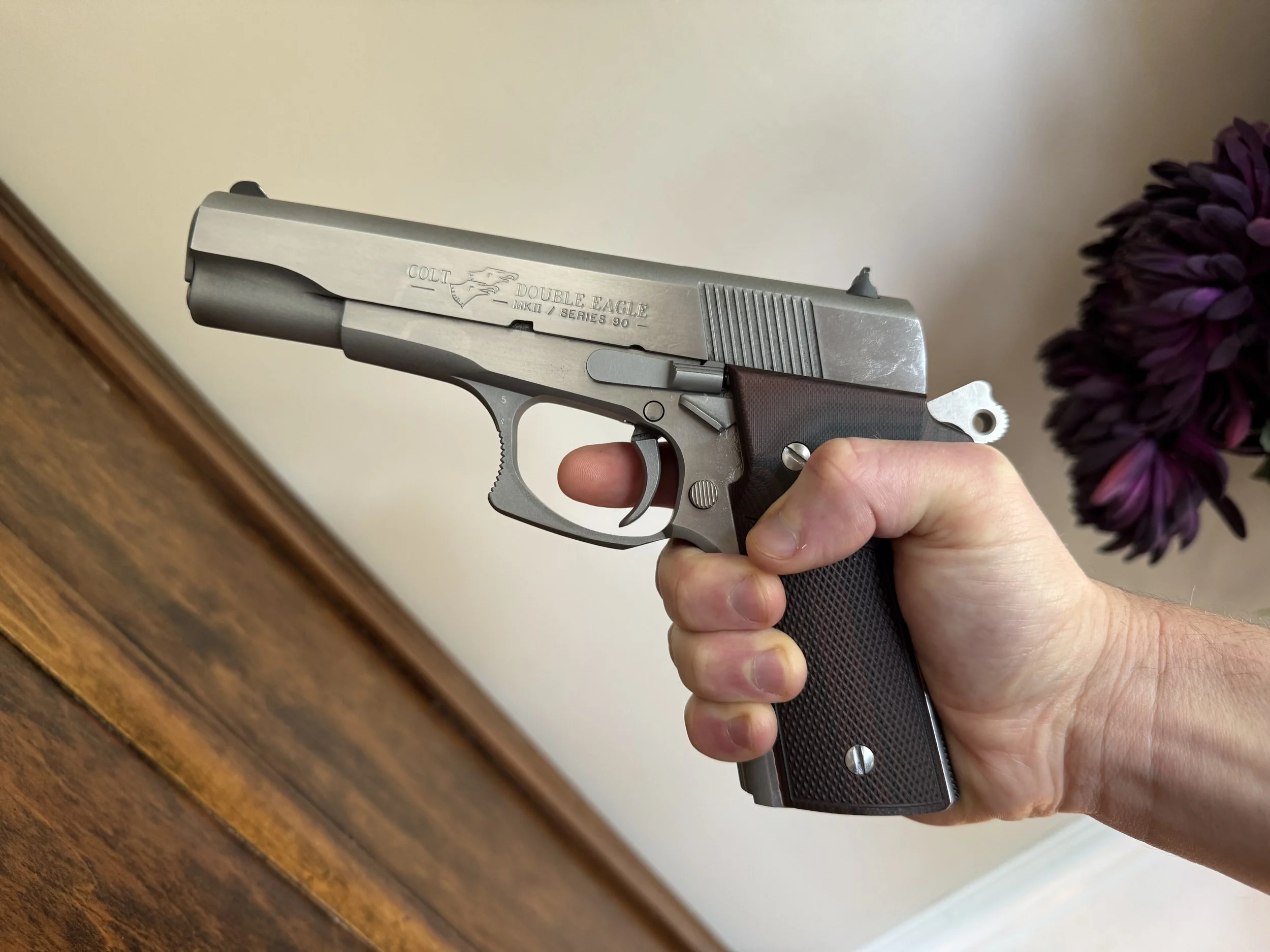
As I said, the lowered trigger guard forces your fingers into the front strap at a more downward angle. Which puts more pressure against the underside of your fingers—more than you’d experience on a normal 1911. After a while, it can feel kinda uncomfortable.
I don’t really notice it when shooting. But if I’m handling the pistol, dry-firing, etc. for a long period of time, I feel a pressure point in my fingers. I might also be a giant freakin’ pucce. So, consider that.
The front strap hits differently
Thumb-Knuckle Awkwardness
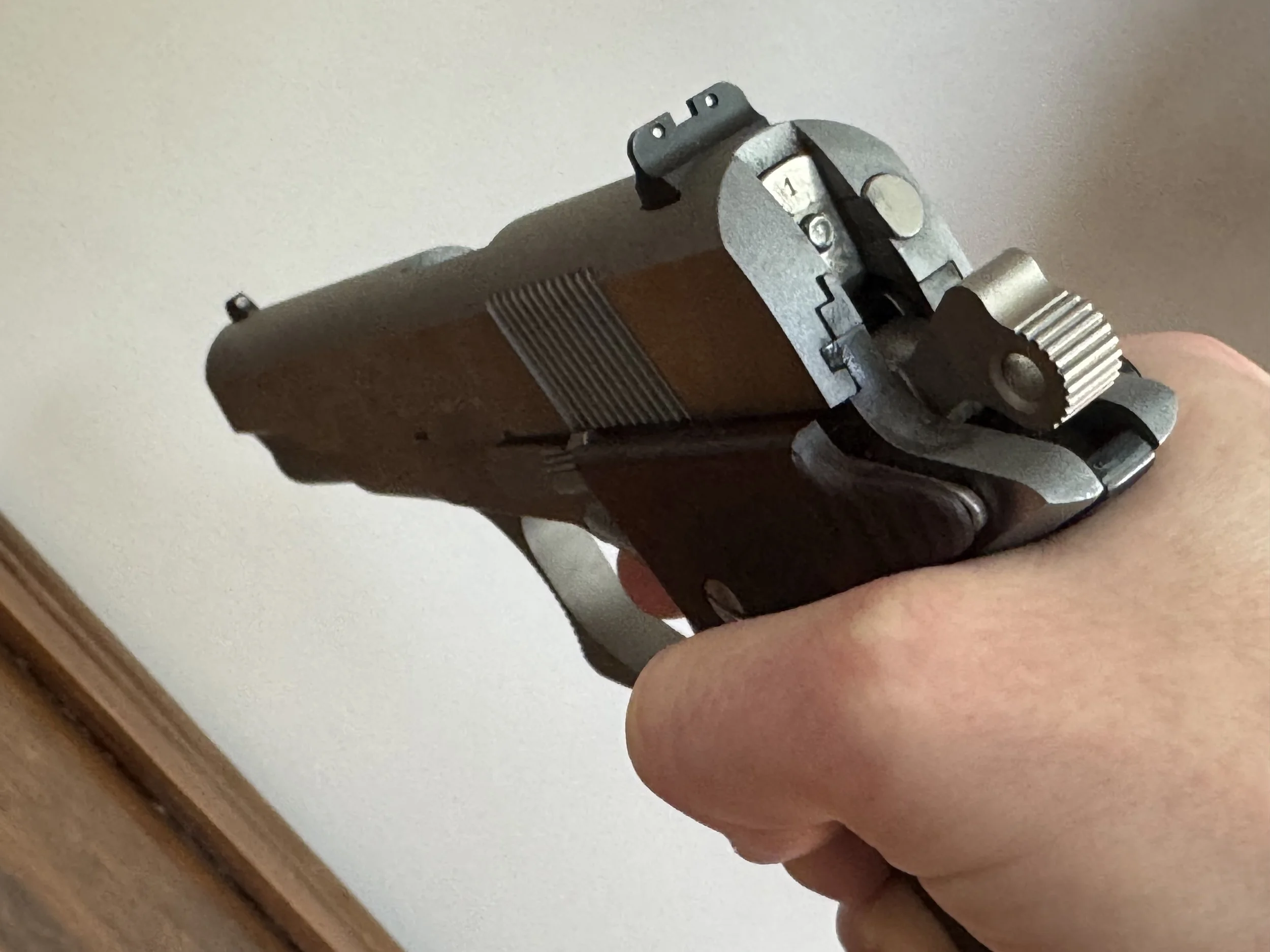
The Double Eagle’s grip panels flare-out on either side of the beavertail—to cover the decocker and the trigger bar. You definitely feel the edge of that flare on your strong-hand thumb knuckle.
Now, I use an old-school thumbs-down grip, so I don’t get hammered by it. But if you’re using a thumbs-up/thumbs-forward kinda grip… it’s gonna be uncomfortable.
Watch your strong-hand knuckle
Trigger-Finger Awkwardness
Since the Double Eagle’s ergos shift your hand lower on the frame, your trigger finger is essentially reaching across the mag-catch area—which can’t be adequately relieved to give your finger clearance (cuzz the mag catch is there, bruh).
So, you feel frame when you pull the trigger. I don’t get pinched, per se—but when the trigger breaks, the pad of my finger is definitely resting against the frame. An overtravel stop would probably solve this. Not that it’s a huge issue, either way.
Again, none of the above make me dislike the gun. Or how it shoots.
But let’s be honest: The thing just isn’t as comfortable or intuitive as a standard 1911.
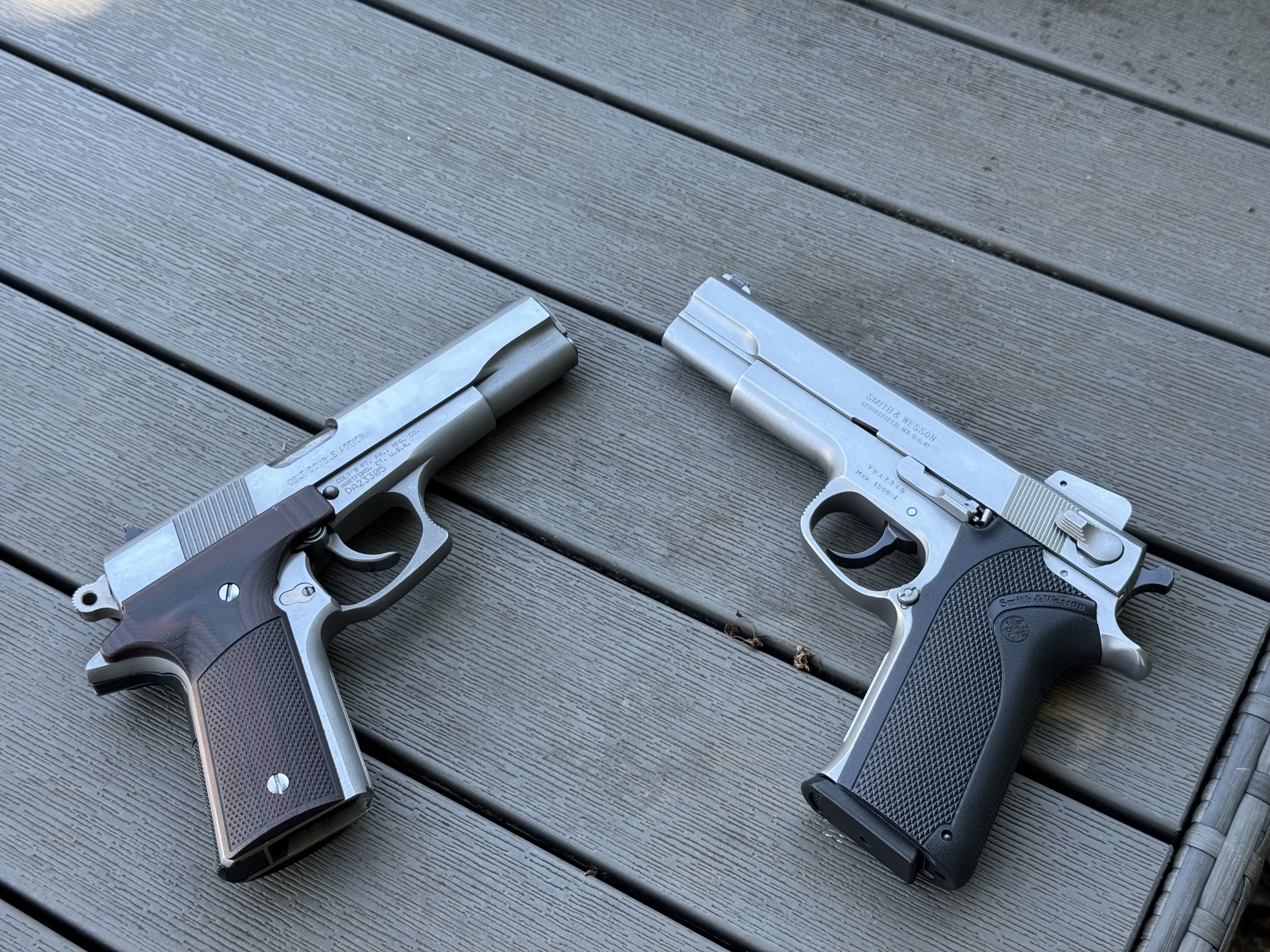
Moreover, these ergonomic anomalies reinforce the notion that the Double Eagle is a retro-fitted 1911. Not a purely native design. After all, the S&W 4506 and the SIG P220 don’t have quirks like this—because they weren’t working around the limitations of an existing design.
The 4506-1 still slaps, bro
Nevertheless, the gun has its merits. Some of which are distinct from—and superior to—what a 1911 offers.
So, if you DO dig the Double Eagle’s funky, irreverent DA/SA mojo…
Reliability & Practicality
Maybe you wanna carry one?
Is it reliable? Is it practical? Will you look like a baddass, flexing in the mirror with it? Well, the answer to all those questions is “yes.” With some minor caveats to the first two.
In terms of reliability…
It’s a 1911. Built right, with the right mags, and the right ammo, a 1911 is Glock reliable.
This one?
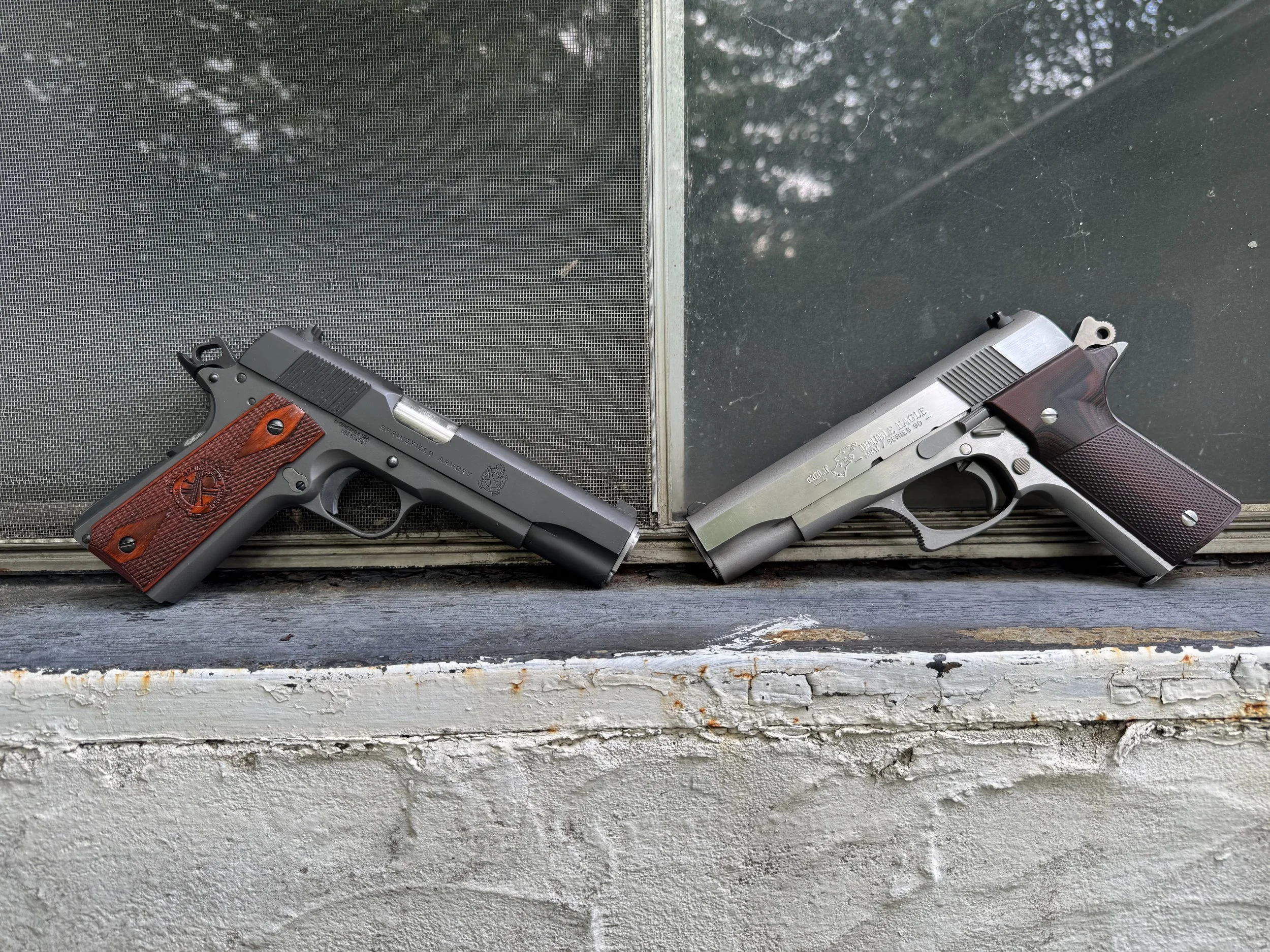
Well, it didn’t like Checkmate GI mags. But neither did my Springfield Mil-Spec—which has never had any kind of an issue before. Both guns experienced FTFeeds with those mags. Which was surprising, because they’re supposed to have the original 1911 feed-lip geometry, optimized for ball rounds (which I was using).
I also had one specific mag that kept giving me inertial feeds (that’s when the round bounces out of the feed lips under recoil). Ironically, it was Colt-branded 7 rounder. I kinda think something was off with the feed lips.
Conversely, the gun ran 100% reliably with:
A Chip McCormick “Shooting Star” 8rd mag (Colt branded)
A Wilson Combat 47D
A Springfield 7 rounder
A Ruger-branded 8 rounder
I’ve probably put +/- 400 rounds through it, evenly spread between all the mags noted above.
They’re actually friends, now
For you 1911 dorks…
I’m no expert, but nothing looks blatantly off in terms of the extractor or the feed ramp. The extractor holds rounds in place when you jiggle the slide and the pad looks properly beveled on the underside. The feed ramp appears to have the right-sized step, transitioning from frame to barrel.
Moreover, there’s zero movement in the barrel hood—which suggests the barrel link is properly engaging the slide stop.
If anything, the extractor hook is slightly too far forward relative to the breech face. But it’s not gouging the casings, so I don’t think it’s really an issue. And I’ve read that Colt extractors tend to be on the long side. Overall, I think we’ve become neurotic about 1911 extractors. If it was that hard to get right, typewriter companies couldn’t have built 90 trillion of them in the ‘40s.
In terms of maintenance…
As mentioned, most of your primary wear parts are all 1911 compatible: springs, mags, sights, barrel, etc.
That said, the plastic back-strap insert—which also houses the mainspring—concerns me a little. These are NOT easily findable online, and they’re 100% proprietary to the Double Eagle. I saw a forum post where a guy had cracked his and wasn’t sure what to do.
I think one could fabricate a metal replacement part. Some combination of a 1911 mainspring housing and a GI beavertail might work—with some grinding and possibly some welding. There’s also “The Answer” safety-less 1911 backstrap from Novak’s. Again, you might be able to mod it so it fits? But not 100% sure.
I might also keep an eye on the springs that run the decocker and position the trigger bar. I’ve broken similar springs on old SIGs. The steel just gets brittle after a while.
Series 90s, MKIIs and Grip Springs
Oh my.
If you scrounge up Double Eagles for sale on the internet, you’ll encounter two “versions”:
The Series 90 and the MKII.
As mentioned, I have an MKII made in 1996 (the last year of production). Now, forum lore suggests that the Series 90 guns had disastrously unsupported springs under the grip panels—which would result in said springs ejecting from the gun if the grip panels were removed.
That’s pretty much BS.
As far as I can tell, the only real difference between Series 90 and MKII Double Eagles is the presence of a “guide” (for lack of a better word) which helps stabilize the trigger bar, under the right grip panel.
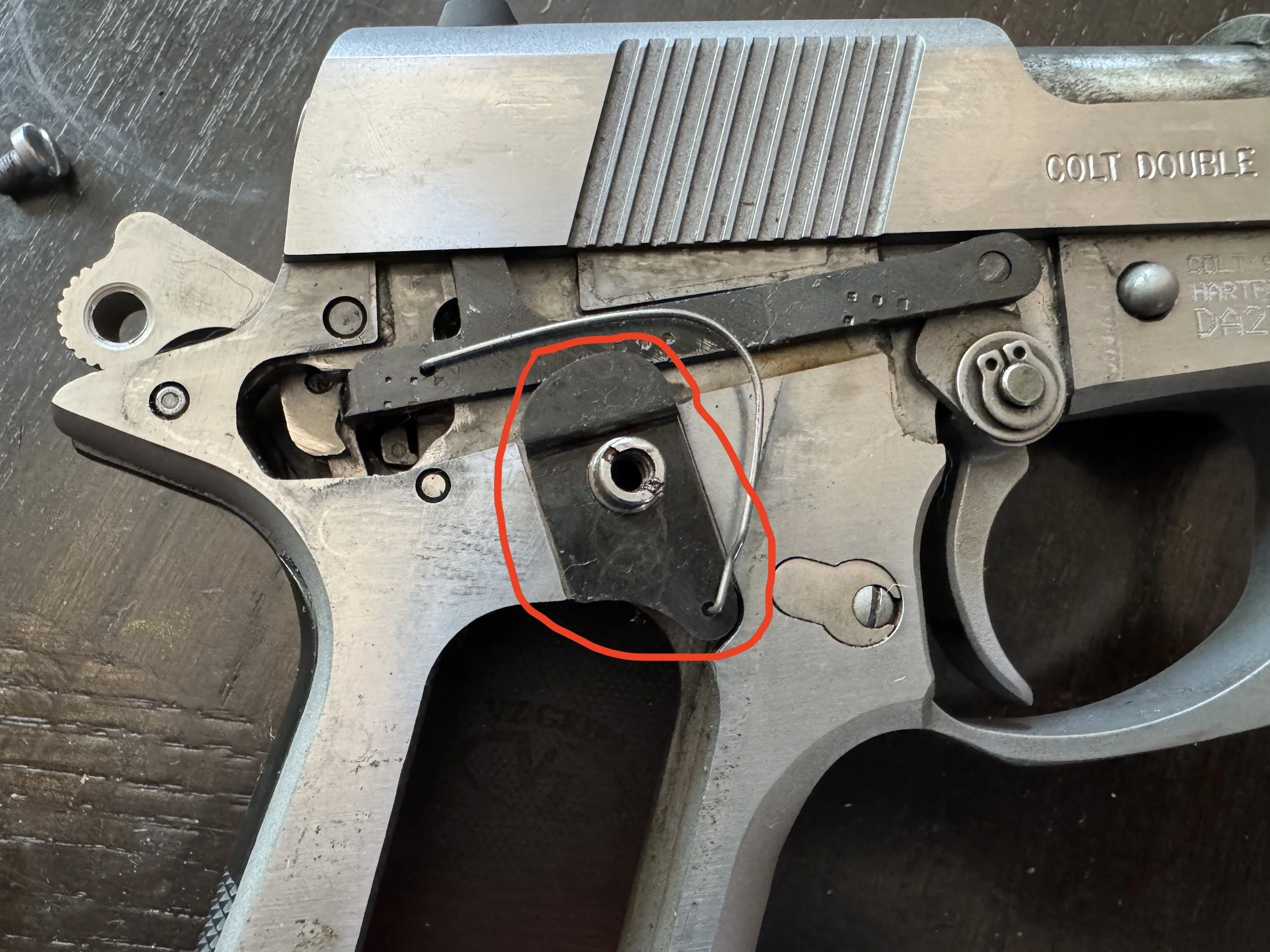
That thing isn’t on the Series 90
But I tend to question the necessity of that addition. On Forgotten Weapons, Ian McCollum disassembles a Series 90 Double Eagle. The trigger bar spring stays firmly in place, even without the “guide” present in the MKIIs.
Now, the decocker spring—under the left grip panel—remains completely unsupported, even on the MKIIs. And yes, the unthinkable happened, when I swapped grips:
I had to re-seat the decocker spring [cue dire orchestral fanfare].
It didn’t fly out. It didn’t injure any unsuspecting bystanders. Or pets. I simply had to nudge one leg of the spring back into its anchor point. And, interestingly, Ian had the same experience on the Series 90 gun he examined. No projectile spring. He just had to reseat it.
Bottom Line:
Don’t worry about the springs. The rumors are vastly overplayed. And based on what I’ve learned, I’m not sure there’s any real advantage in finding an MKII over an earlier Series 90. Other than, perhaps, the inherent advantages of buying a later-production example of anything.
Poignant Conclusion
Call me a heretic. Call me a tactical apostate. Tell me I’ve sinned against the hallowed name of John Moses Browning. Regardless, I’ll tell YOU the same thing:
I freakin’ love the Colt Double Eagle. No, it ain’t perfect. But, if you ask me, it offers a uniquely worthwhile take on a DA/SA service pistol in .45.
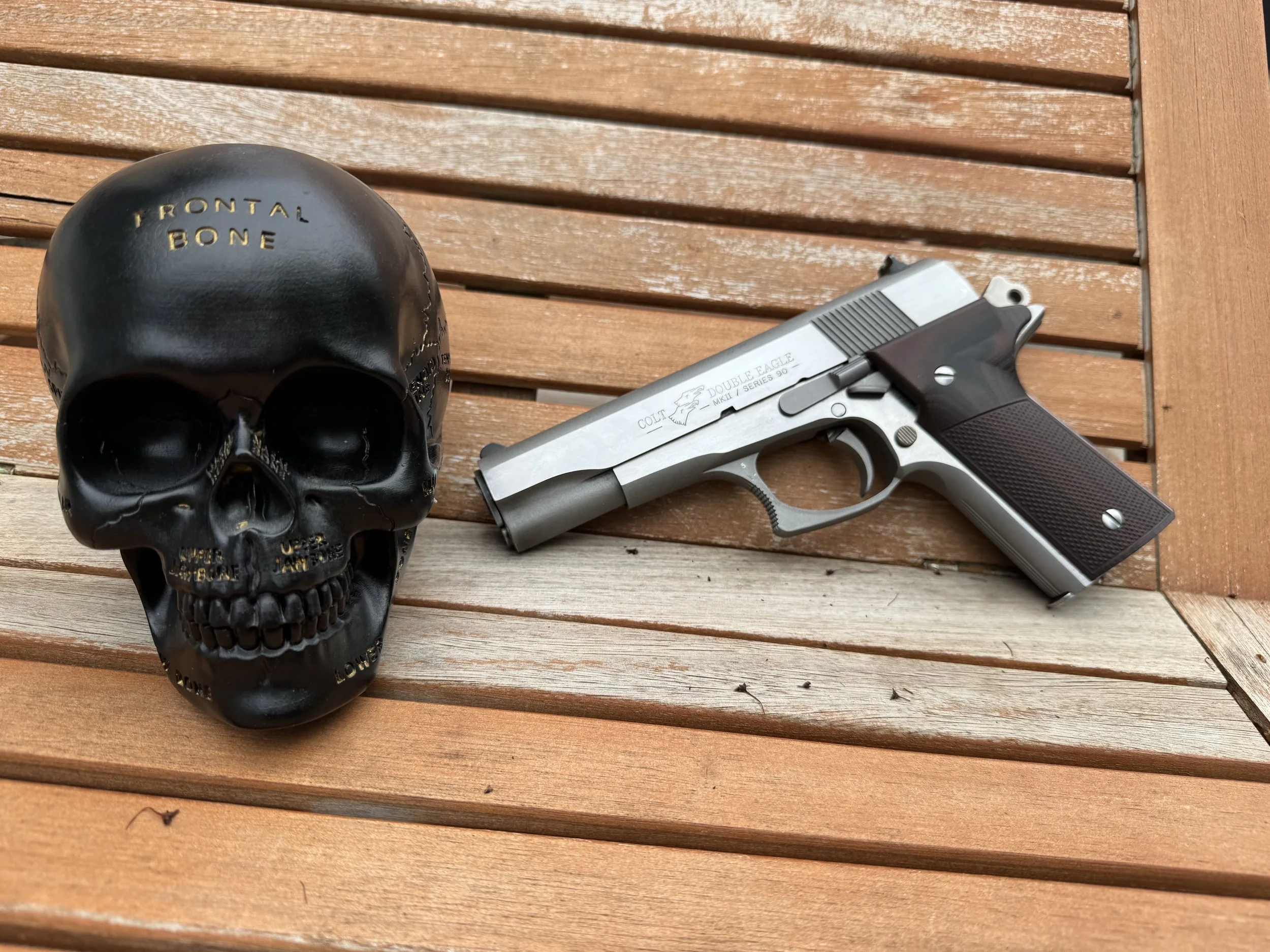
I do not fear the dark side, as you do
Honestly, I think it provides a more intuitive—and more viscerally stimulating—shooting experience versus its primary competitors: the Smith 4506 and the SIG P220. Now, I own a 4506 and I’ve owned multiple SIG Sauer P-Series pistols in .45 ACP.
I love all of the above.
But the Double Eagle does the DA/SA dance in a distinctively dope way. It’s a little quirky. It’s a little edgy. But if you give it half a chance to corrupt your conformist sensibilities as it relates to big-bore service pistols…
It’ll make you a true believer.
Thank you so much for reading.
What are your thoughts on the Colt Double Eagle? Experiences? Opinions? Scathing condemnations on my review? Feel free to share below…
#hiptac
© 2026, Hipster Tactical